
In step 8 we saw how a propeller produces thrust. But what turns the propeller? On most model airplanes today the answer is: electricity. In this step we get to know the power chain made up of the battery, the ESC and the motor.
The power chain
- Battery: Stores energy and supplies direct current (DC).
- ESC (electronic speed controller): Adjusts the power going to the motor according to the throttle signal from the receiver. It drives the brushless motor with three-phase current.
- Brushless motor: Converts electrical energy into rotation.
- Propeller: Converts rotation into thrust.
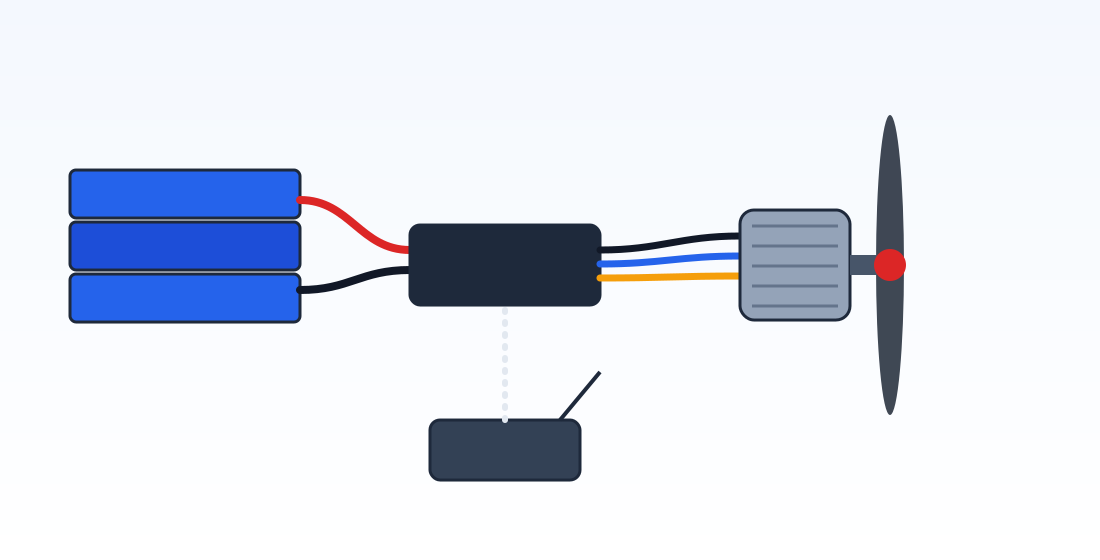 LiPo battery3S = 3 × 3.7 V = 11.1 VESCspeed controllerDC3-phaseBrushless motorKv: rpm per voltPropellerReceiverthrottle signal
Understanding the LiPo battery
The most common battery type on model airplanes is the lithium polymer (LiPo) battery. According to the AMA's (Academy of Model Aeronautics) basics guide:
- Cell voltage: The nominal voltage of a LiPo cell is 3.7 V and its fully charged voltage is 4.2 V.
- Cell count (S): Cells are connected in series. A "3S" battery has a nominal voltage of 3 × 3.7 = 11.1 V.
- Capacity (mAh): The amount of charge the battery stores. 2,200 mAh = 2.2 Ah.
- C rating: Determines the continuous current the battery can safely supply: Maximum current = C × capacity. A 2,200 mAh battery rated 25C can supply 25 × 2.2 = 55 A of continuous current.
The battery's energy is voltage times capacity: 11.1 V × 2.2 Ah ≈ 24 Wh.
Kv: the motor's speed character
Brushless motors carry a number such as "1000 Kv". As Horizon Hobby explains, Kv is the motor's revolutions per minute per volt (with no load). A 1,000 Kv motor on 11.1 V turns at about 11,100 rpm with no load. With a propeller fitted, the speed drops.
- Low Kv: Turns more slowly; turns a large-diameter propeller more easily. For slow, heavy models and gliders.
- High Kv: Turns faster; used with small propellers. For speed models.
The warning from step 8 applies here too: the wrong (too large) propeller forces excessive current through the motor, the ESC and the battery.
Choosing an ESC
An ESC carries a continuous current rating such as "30 A". This value must be greater than your system's current at full throttle. Measuring the full-throttle current with a wattmeter is the most reliable way. An ESC running at its limit heats up and can shut down to protect itself; in the air, this means the motor suddenly stops. The same rule applies to the battery: the full-throttle current must stay below the battery's C × capacity limit.
The AMA's guide also recommends that the ESC's low-voltage cutoff be set above 3 V per cell. Taking a LiPo cell below this voltage damages it permanently.
Calculating flight time
A rough calculation of flight time is simple:
Flight time (min) = Usable capacity (Ah) / Average current (A) × 60
The AMA recommends using only about 80% of a LiPo battery's capacity. With a 2,200 mAh battery and an average current of 12 A over the flight:
0.8 × 2.2 / 12 × 60 ≈ 8.8 minutes
What matters here is the average current. A model that draws 24 A at full throttle but spends most of the flight at half throttle has a much lower average.
LiPo safety
LiPo batteries have a high energy density and can start a fire if misused. The basic rules in the AMA's guide:
- Use a charger that is suitable for LiPo and has balancing; charge at 1C unless stated otherwise.
- Never leave the battery unattended while charging; use a fireproof container or bag.
- Do not use swollen, crushed or damaged batteries.
- If you will not use them for a long time, store them at a storage voltage of 3.8–3.9 V per cell.
Try it yourself
Enter your battery's cell count, capacity and C rating, your motor's Kv and the currents you measured. Raise the full-throttle current above 30 A and see the ESC warning. In the 3D view the yellow dots show the current, and the gauge shows the remaining capacity throughout the flight.
JavaScript must be enabled in your browser for this interactive tool.
Next step
In the last step of the series we bring together everything we have learned: how do you choose your first model airplane, how do you stay safe at the field, and what are the current rules in Türkiye?
Sources
- Academy of Model Aeronautics (AMA) Flight School. LiPo Battery Basics
- Horizon Hobby. Introduction to Electric Power Systems for RC Aircraft
- NASA Glenn Research Center. Propeller Thrust
This article was written by SVR AEROTECH as original work, drawing on the sources above; the figures belong to SVR AEROTECH. Quoted information belongs to the respective source owners.