
Imagine trying to swim across a river. If you swim straight towards the opposite bank, the current carries you downstream. To arrive directly opposite, you need to swim slightly into the current. The situation is exactly the same for an airplane flying in wind.
Three speeds, one triangle
In aviation three speeds are kept apart:
- Airspeed: The airplane's speed relative to the air. This is the speed the wing sees.
- Wind: The movement of the air relative to the ground.
- Groundspeed: The airplane's speed relative to the ground. This decides the arrival time.
The wind triangle in the navigation chapter of the FAA's handbook links these three: the sum of the airspeed vector and the wind vector gives the groundspeed vector. In wind, the direction the airplane's nose points (heading) and the path it follows over the ground (course) are not the same.
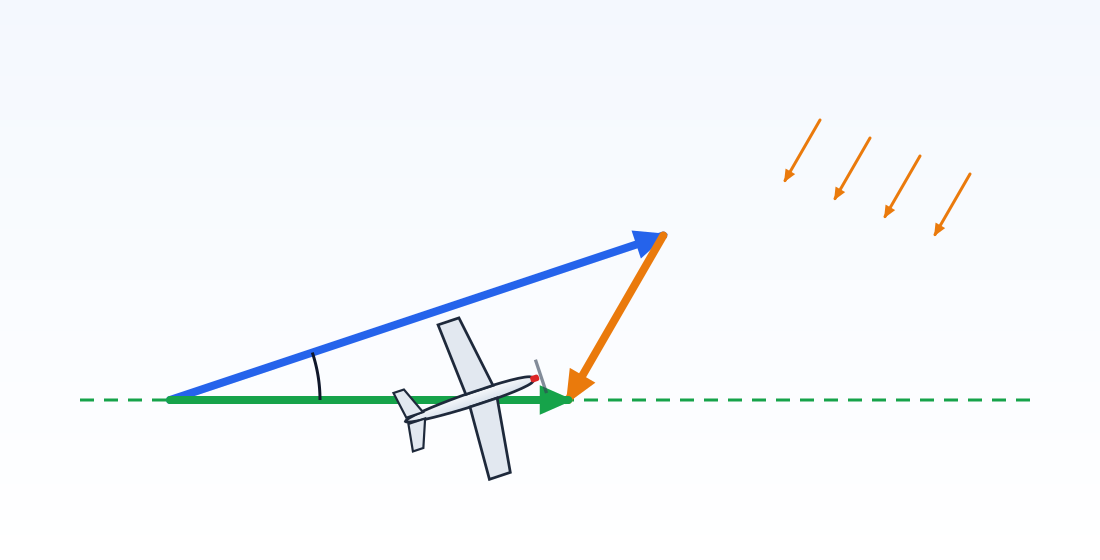 Airspeed · headingWindGroundspeed · course flownWCAThe wind is blowing from ahead on the leftThe nose is turned into the wind; the airplane moves sideways like a crab but stays on course.
Splitting the wind in two
Splitting the wind into two components relative to your flight course makes things easier. If we call the angle between the wind and the course θ:
- Headwind component = W · cos θ: Reduces groundspeed (if negative it is a tailwind, which increases groundspeed).
- Crosswind component = W · sin θ: Pushes the airplane sideways off the course.
Wind correction angle
To counter the effect of a crosswind, the nose is turned slightly into the wind. This angle is called the wind correction angle:
sin(WCA) = Crosswind / Airspeed
At this angle the airplane moves along its course like a crab, turned slightly sideways.
An example
You want to fly a course of 90° (east) at an airspeed of 60 km/h. The wind is blowing at 20 km/h from 30°:
- The angle between the wind and the course is 60°.
- Headwind component: 20 · cos 60° = 10 km/h
- Crosswind component: 20 · sin 60° ≈ 17.3 km/h (from the left)
- Wind correction angle: sin⁻¹(17.3 / 60) ≈ 16.8° to the left
- Heading to hold: about 73°
- Groundspeed: 60 · cos 16.8° − 10 ≈ 47 km/h
If you make no correction and keep the nose at 90°, the airplane drifts about 19° to the right: it slides about 350 m sideways for every kilometre.
Practical takeaways for model flyers
When you watch a model airplane from the ground, the wind triangle shows itself in these situations:
- When flying into the wind the model seems to have slowed down; downwind it seems to have sped up. The airspeed is the same; what changes is the groundspeed. Being fooled into thinking the model has "sped up" when turning downwind and reducing the throttle is dangerous.
- A model flying downwind moves away faster than you expect. Do not let the model drift far downwind; the return will be slow.
- On a crosswind landing the model approaches the runway turned sideways. Stay on the runway line with a slight heading correction.
- In a wind stronger than your own airspeed the model moves backwards over the ground. This is why light models are not flown on windy days.
Try it yourself
Change the course and the wind. In the 3D view the green dashed line shows your desired course, the blue arrow the heading, the orange arrow the wind and the green arrow the groundspeed. The red dashed line is the path you would follow if you made no correction.
JavaScript must be enabled in your browser for this interactive tool.
Next step
So far we have kept where thrust comes from limited to the propeller article. In the next step we look at the power system of an electric model airplane: battery, ESC, motor and flight time.
Sources
- Federal Aviation Administration (FAA). Pilot's Handbook of Aeronautical Knowledge (FAA-H-8083-25C). Chapter 16: Navigation (wind triangle, wind correction angle, groundspeed)
- Federal Aviation Administration (FAA). Airplane Flying Handbook (FAA-H-8083-3C). Chapters 6 and 9: crosswind take-off and landing
This article was written by SVR AEROTECH as original work, drawing on the sources above; the figures belong to SVR AEROTECH. Quoted information belongs to the respective source owners.