
Take-off and landing are the two critical moments of flight when the runway meets the air. In both, the airplane is at low speed and close to the ground; there is little room for error. In this step we look at the rules that govern these two moments.
An airplane takes off relative to the air
What the wing sees is airspeed, not speed over the ground. The airplane lifts off when it reaches the airspeed at which the wing produces enough lift. This speed is a little above the stall speed; in the examples in this article we use 1.2 times the stall speed.
According to the FAA's flying handbook, a headwind gives the airplane some airspeed before it even starts to accelerate. The groundspeed the airplane needs to reach this airspeed decreases; and as groundspeed decreases, the ground roll gets shorter.
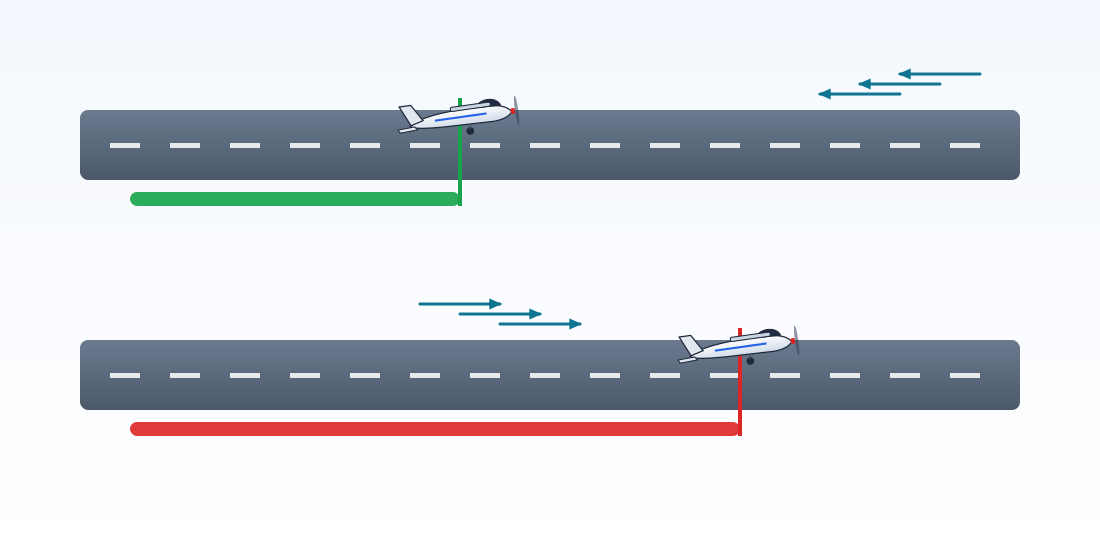 HeadwindTailwindshort ground rolllong ground rollwindwindLifts off at the same airspeed; with a headwind this speed is reached at a lower groundspeed.
The ground roll is roughly proportional to the square of groundspeed. That is why the effect of wind is larger than expected. The rule of thumb in the FAA's handbook: a headwind of 10% of the take-off speed shortens the take-off distance by about 19%; a tailwind of the same size lengthens it by about 21%.
An example with a model airplane
Let us consider a trainer model with a mass of 1.4 kg, a wing area of 30 dm² and a static thrust of 6 N on an asphalt runway. Its stall speed is about 7.9 m/s and its lift-off speed about 9.5 m/s:
- No wind: about 16.6 m of ground roll
- With a 3 m/s headwind: about 8.3 m
- With a 2 m/s tailwind: about 23.3 m
On model airplanes the wind speed is large compared with the take-off speed, so its effect is much more noticeable than on full-size airplanes. A headwind of a few m/s can halve the ground roll.
Other factors
- Weight: A heavier airplane has a higher stall speed and lift-off speed; with the same thrust it accelerates more slowly. The ground roll gets longer on both counts.
- Runway surface: Grass increases the rolling resistance of the wheels. In long or wet grass the ground roll gets noticeably longer.
- Density altitude: As we saw in step 7, at hot and high fields the true speed needed increases and thrust decreases.
- Wind direction: If the runway is not exactly into the wind, only the headwind component of the wind shortens the ground roll; the crosswind component pushes the airplane sideways. We will look at this in detail in the next step.
Flaps
Flaps are surfaces on the trailing edge of the wing that can be lowered. According to the FAA's handbook, flaps increase both lift and drag by increasing the wing's camber. As a result, the airplane:
- Stalls at a lower speed; it can take off and land more slowly.
- Can descend at a steeper angle on landing without speeding up.
For take-off, a small amount of flap (or none) is usually used. The large drag produced by full flap weakens acceleration and climb. On landing, full flap reduces the approach speed and the landing distance. On a real airplane the correct flap setting is in the airplane's handbook.
Landing: the same rules in reverse
On landing, too, the airplane flies relative to the air. A headwind means a lower groundspeed at the same approach airspeed; the airplane stops in a shorter distance. A tailwind landing means both a longer distance and the risk of running off the end of the runway. That is why both take-off and landing are done into the wind whenever possible.
Practical takeaways for model flyers
- When you arrive at the field, check the wind first. A windsock, moving trees or a blade of grass is enough.
- Do not take off with a tailwind. The ground roll gets longer, and if you try to "force" the airplane off the ground there is a risk of a stall.
- In a crosswind, hold aileron into the wind at the start of the take-off roll; the FAA's handbook recommends this to stop the upwind wing from lifting. Use the rudder for direction.
- On a grass field, plan for a longer ground roll and more thrust.
Try it yourself
Increase the wind from 0 to 3 m/s and watch how the red flag (the lift-off point) moves back compared with the grey flag (no wind). Then set the wind to −2 m/s. Compare by changing the flaps and the runway surface too.
JavaScript must be enabled in your browser for this interactive tool.
Next step
Wind affects not only the take-off but the whole flight. In the next step we will see how to fly a straight course in wind, groundspeed and the wind correction angle.
Sources
- Federal Aviation Administration (FAA). Airplane Flying Handbook (FAA-H-8083-3C). Chapter 6: Takeoffs and Departure Climbs (headwind, crosswind take-off, flaps); Chapter 9: Approaches and Landings
- Federal Aviation Administration (FAA). Pilot's Handbook of Aeronautical Knowledge (FAA-H-8083-25C). Chapter 6: Flight Controls (flaps); Chapter 11: Aircraft Performance (effect of wind on take-off and landing distance)
- NASA Glenn Research Center. Lift Equation
This article was written by SVR AEROTECH as original work, drawing on the sources above; the figures belong to SVR AEROTECH. Quoted information belongs to the respective source owners.