
In step 9 we saw that there is a speed at which total drag is lowest, that is, at which L/D is highest. This speed becomes very valuable when the motor stops.
Gliding: gravity takes the place of thrust
When the motor stops, there is no thrust pulling the airplane forward. The airplane descends gently, using a component of its weight like "thrust". The relationship on NASA's glide angle page is very simple:
tan γ = h / d = D / L = 1 / (L/D)
Here γ is the glide angle, h is the height lost and d is the horizontal distance. So in still air:
Horizontal distance ≈ Height × L/D
A model with an L/D of 10 glides about 1,000 m in still air from a height of 100 m. A glider with an L/D of 30 goes 3 km from the same height. This is why L/D is also called the glide ratio.
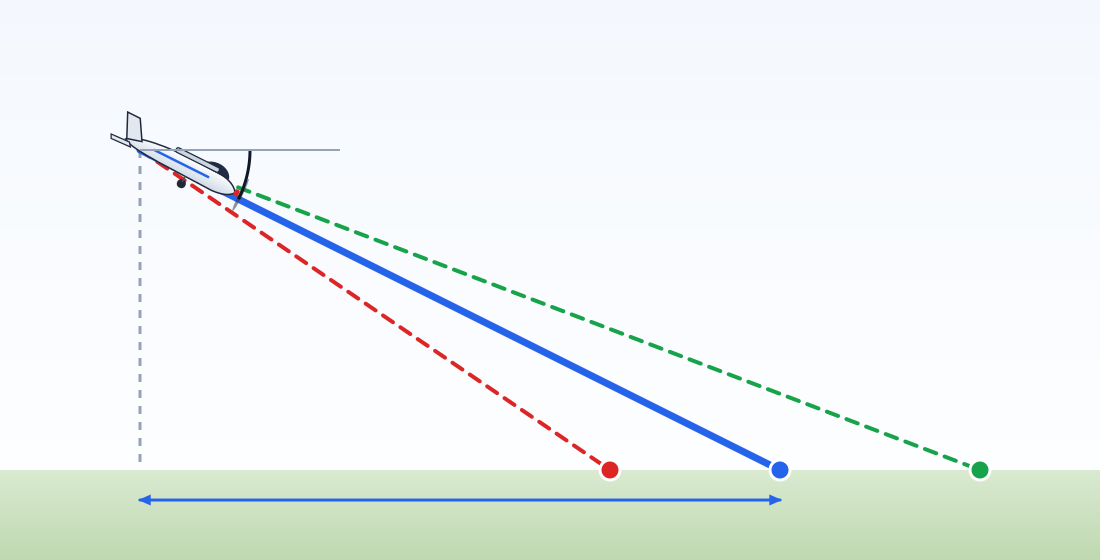 hd = h × L/D still airγHeadwind: shorterTailwind: longertan γ = h / d = 1 / (L/D)The glide time does not change with wind; the distance over the ground does.
The best glide speed
L/D is not a fixed number; it changes with speed and reaches its highest value at the best glide speed. The FAA's flying handbook advises setting up this speed immediately after an engine failure. Flying slower or faster than this speed means covering a shorter distance from the same height.
The FAA's handbook points out another interesting point: As long as it is flown at the right speed, weight does not change the glide distance. A heavy airplane descends faster because its best glide speed is higher, but it glides at the same angle to the same distance. This is also the purpose of water ballast in gliders: to travel faster with the same glide ratio.
The effect of wind
An airplane flies relative to the air. If the air itself is moving, the airplane is carried along with it. Our model with an L/D of 10, gliding at 12 m/s from 100 m, descends about 1.2 m per second and stays in the air for 83 seconds. This time does not depend on the wind. What changes is the distance covered over the ground:
- In still air: about 995 m
- With a 3 m/s headwind: about 745 m
- With a 3 m/s tailwind: about 1,245 m
The FAA's handbook also states that a headwind shortens the glide distance and a tailwind lengthens it. In a strong headwind, flying a little above the best glide speed can increase the distance over the ground.
Climbing: excess thrust and excess power
In level flight thrust equals drag. If thrust is greater than drag, the difference makes the airplane climb. The distinction in the FAA's performance chapter is as follows:
- Climb angle depends on excess thrust: sin γ = (T − D) / W
- Rate of climb depends on excess power: vertical speed = (T − D) · V / W
The best values of these two quantities are obtained at different speeds. The FAA's flying handbook defines them as follows:
- Vx (best angle of climb speed): The most height per unit of distance over the ground. For clearing obstacles.
- Vy (best rate of climb speed): The most height per unit of time. For normal climbs.
In our example the 1.4 kg model has 1.37 N of drag at 12 m/s. If the motor gives 3 N of thrust, the excess thrust is 1.63 N; the airplane climbs at an angle of about 6.8°, at about 1.4 m per second.
Practical takeaways for model flyers
- If the motor cuts out, lower the nose slightly and keep your speed. Trying to "stretch" the glide by raising the nose reduces speed; the glide gets shorter and a stall risk appears.
- Plan your landing into the wind. If your landing spot is downwind, you will touch down earlier than you expect.
- Climb close to Vx if there is an obstacle, otherwise close to Vy. These speeds are not measured on a model airplane, but the principle is the same: do not slow down more than necessary for a steep climb.
Try it yourself
First leave the thrust at 0 and change the wind between −5 and +5 m/s; notice that the time in the air does not change, while the landing point does. Then increase the thrust to 3 N and watch the airplane start to climb.
JavaScript must be enabled in your browser for this interactive tool.
Next step
We move on to the two most critical moments of flight: take-off and landing. We will see how the wind, the flaps and the runway surface change the take-off distance.
Sources
- NASA Glenn Research Center. Glide Angle
- NASA Glenn Research Center. Lift to Drag Ratio
- Federal Aviation Administration (FAA). Airplane Flying Handbook (FAA-H-8083-3C). Chapter 6: Takeoffs and Departure Climbs (Vx, Vy); Chapter 18: Emergency Procedures (best glide, effect of weight and wind)
- Federal Aviation Administration (FAA). Pilot's Handbook of Aeronautical Knowledge (FAA-H-8083-25C). Chapter 11: Aircraft Performance (climb performance, excess thrust and excess power)
This article was written by SVR AEROTECH as original work, drawing on the sources above; the figures belong to SVR AEROTECH. Quoted information belongs to the respective source owners.