
A well-trimmed trainer model returns to level flight on its own after a gust, even if the pilot does nothing. An aerobatic model, on the other hand, tends to stay in whatever attitude it is in when you let go of the controls. The name of this difference is stability.
Static stability: the initial tendency
The FAA's handbook defines static stability as the initial tendency an airplane shows when its equilibrium is disturbed. There are three cases:
- Positive static stability: The airplane tends to return to its original state. Like a ball at the bottom of a bowl.
- Neutral static stability: The airplane stays in its new state. Like a ball on a flat table.
- Negative static stability: The airplane moves further away from where it was disturbed. Like a ball on top of a hill.
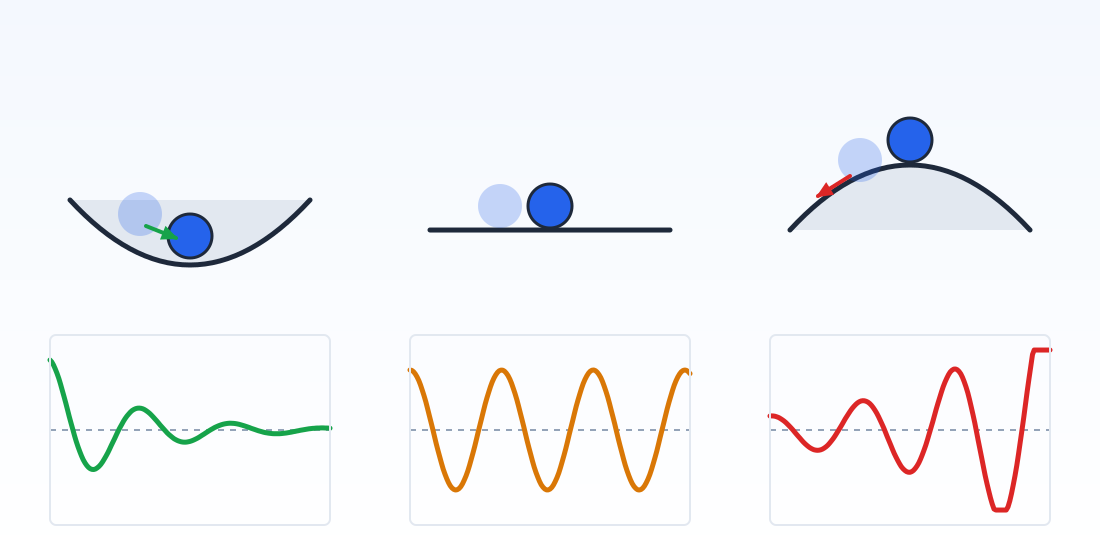 Positive static stabilityNeutralNegativereturns when pushedstays in its new placemoves away when pushedDamped oscillationConstant oscillationGrowing oscillationpositive dynamic stabilityneutral dynamic stabilitynegative dynamic stability
Dynamic stability: what happens over time?
Static stability only tells us the initial tendency. An airplane that tends to return to its original state can overshoot and oscillate. Dynamic stability is how this motion changes over time:
- Positive: The oscillations get smaller and die out.
- Neutral: The oscillations continue at the same size.
- Negative: The oscillations grow.
Positive dynamic stability first requires positive static stability; but that alone is not enough. There must also be an effect that damps the motion.
Longitudinal stability: centre of gravity and the horizontal tail
Stability about the pitch axis (nose up–down) is closely tied to the centre of gravity (CG) we saw in step 6. Every airplane has a neutral point: if the centre of gravity were at this point, the airplane would be neutrally stable in pitch. The further the centre of gravity is ahead of the neutral point, the more stable the airplane. The ratio of this distance to the mean aerodynamic chord is called the static margin.
Let us see how it works: when a gust lifts the nose, the angle of attack of both the wing and the horizontal tail increases. Because the tail is far from the centre of gravity, the increase in its lift creates a large turning effect and turns the nose back down. The tail also damps the motion: as the nose rises and falls quickly, the tail is swept up and down through the air, and this motion produces a force that opposes itself.
Stability in roll: dihedral
Airplanes whose wings form a slight upward "V" when seen from the front have dihedral. NASA's wing geometry page states that dihedral gives the airplane stability in roll.
When the airplane is banked by a gust, the lift force also tilts sideways and the airplane starts to slip towards the lower wing. In this sideslip, thanks to dihedral, the lower wing meets the air at a larger angle of attack and produces more lift. The result is an effect that levels the wings again. On high-wing airplanes, having the centre of gravity below the wing has a similar effect (the FAA describes this as the "keel effect").
This is why trainer models have noticeable dihedral. Aerobatic models, on the other hand, usually have no dihedral, so that they hold the bank they are in when the controls are released.
Directional stability: the vertical tail
The vertical tail works like a weathervane. When a gust turns the airplane's nose sideways, the vertical tail meets the air from the side and turns the nose back into the flow. The FAA's handbook compares this to the behaviour of a weathervane.
Is stability always good?
A very stable airplane resists disturbances but also responds reluctantly to the controls. On trainers stability comes first; on aerobatic airplanes agility does. In design, a balance is struck between the two.
Try it yourself
A gust raises the airplane's nose by 8°. First leave the static margin at 10, then reduce it to 0 and −5. Then switch the axis to "Roll" and change the dihedral angle. Compare the behaviour of the curve on the graph and of the airplane in the 3D view.
JavaScript must be enabled in your browser for this interactive tool.
Next step
We return to the performance of a stable airplane: how far does the airplane glide when the motor stops? How much extra power does it need to climb?
Sources
- Federal Aviation Administration (FAA). Pilot's Handbook of Aeronautical Knowledge (FAA-H-8083-25C). Chapter 5: Aerodynamics of Flight (static and dynamic stability, longitudinal, lateral and directional stability)
- NASA Glenn Research Center. Wing Geometry Definitions. Dihedral and roll stability
- NASA Glenn Research Center. Aircraft Center of Gravity
This article was written by SVR AEROTECH as original work, drawing on the sources above; the figures belong to SVR AEROTECH. Quoted information belongs to the respective source owners.