
With this post we start the Step by Step Aviation series. Every other day we will move the fundamentals of flight one step further. The first step is the foundation of everything else: the four forces acting on an airplane in flight.
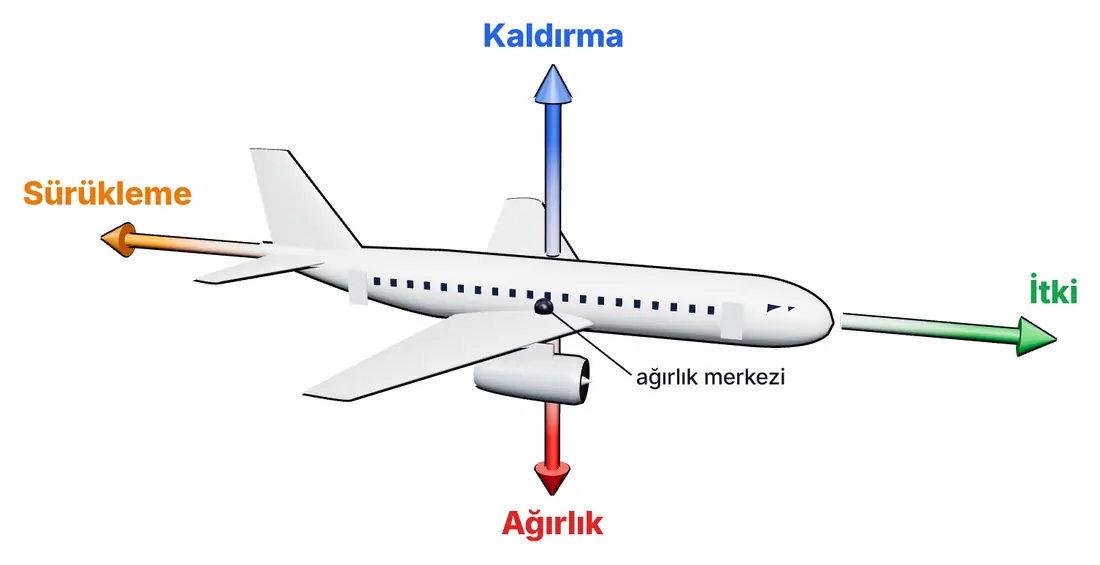
An airliner and a model airplane you fly in the park obey the same laws of physics. Every airplane flying at a constant speed, at the same altitude and in a straight line is acted on by four basic forces: lift, weight, thrust and drag.
1. Weight: gravity's share
Weight is the Earth pulling the airplane towards itself, and it always points down, towards the centre of the Earth. The fuselage, wings, engine, fuel or battery and the payload all add to the total weight.
In calculations, weight is assumed to act at a single point called the centre of gravity. Where this point lies is very important for the airplane's balance; we will devote a separate step to it.
2. Lift: the force that opposes weight
Lift is the aerodynamic force that keeps the airplane in the air, and it is produced mostly by the wings. It acts perpendicular to the direction of flight; in level flight it points up.
Lift needs two things: air and motion. The wing must be in contact with air, and there must be a relative speed between the air and the wing. In a place with no air a wing is useless, and if no air flows over the wing there is no lift either. (Even a model standing on the ground can produce lift in a strong wind; that is why models are tied down on windy days.)
3. Drag: the resistance of the air
Drag is the resistance of the air to motion, and it acts exactly opposite to the direction of flight. It depends on the shape of the airplane, the density of the air and the speed. Drag grows quickly with speed; with the same shape and angle of attack, doubling the speed roughly quadruples the drag. ("Induced drag", a by-product of lift, actually decreases as speed increases; we will see this later.)
The force you feel when you hold your hand out from a moving bicycle is also a kind of drag.
4. Thrust: the force that overcomes drag
Thrust is the force produced by the engine that pushes the airplane forward. On propeller aircraft the propeller accelerates air backwards; in jet engines hot gases are expelled from the engine at high speed. In both cases, as air or gas is pushed one way, the airplane is pushed the other way.
What happens when the forces are balanced?
This is where Newton's first law comes in: if the forces acting on a body are balanced, the body either stays at rest or keeps moving at a constant speed in the same direction.
So if lift equals weight and thrust equals drag, the airplane does not stop; it keeps flying at the same speed and the same altitude. This is called straight and level flight.
When one force is larger than the other, the airplane accelerates in the direction of the larger force:
- If thrust is greater than drag, the airplane speeds up.
- If drag is greater than thrust, the airplane slows down.
- If lift is greater than weight, the airplane accelerates upwards and starts to climb.
- If weight is greater than lift, the airplane starts to descend.
What does this mean for a model flyer?
- Every gram counts. The heavier your model, the more lift the wings must produce. That means a higher flying speed and a higher stall speed.
- The motor and propeller must overcome drag comfortably. With an underpowered motor the airplane cannot reach take-off speed or cannot climb.
- Where the weight sits also matters. Moving the battery a few centimetres forward or back changes how the airplane behaves.
Try it yourself
Set the four forces yourself in the tool below. When you make lift equal to weight and thrust equal to drag, see why the airplane does not stop but keeps flying at a constant speed.
JavaScript must be enabled in your browser for this interactive tool.
Next step
We said that lift keeps the airplane in the air; but how does the wing produce this force? A common explanation that still circulates on the internet and in some textbooks is actually wrong. In the next step we will look at this mistake and at the correct explanation together.
Sources
- NASA Glenn Research Center. Four Forces on an Airplane
- NASA Glenn Research Center. What is Lift?
- NASA Glenn Research Center. Newton's Laws of Motion
- Federal Aviation Administration (FAA). Pilot's Handbook of Aeronautical Knowledge (FAA-H-8083-25C). Chapter 5: Aerodynamics of Flight
This article was written by SVR AEROTECH as original work, drawing on the sources above; the figures belong to SVR AEROTECH. Quoted information belongs to the respective source owners.