
In the first step we said that the force that keeps an airplane in the air is lift and that the wings produce it. In this step we look at how the wing produces this force. First, let us clear up a very common misconception.
The common mistake: "equal transit time"
Many sources give an explanation like this: the upper surface of the wing is more curved, so it is longer. Air particles that separate in front of the wing must meet again behind it at the same moment. Because the air on top travels a longer path, it flows faster; faster air has lower pressure, and this pressure difference pushes the wing up.
It sounds logical, but the basis of this explanation is wrong. NASA and teaching resources in aerodynamics state this clearly:
- There is no rule that the particles meet at the back. Wind tunnel and smoke experiments show that the air passing over the top reaches the trailing edge earlier than the air passing underneath.
- A longer path is not required. Symmetric wings, whose upper and lower surfaces are identical, also produce lift. A paper airplane made from a flat sheet, or a sail that is almost a thin plate, produces lift too.
- It cannot explain inverted flight. Aerobatic airplanes can fly upside down; according to the theory that should be impossible.
- The numbers do not add up. The speed difference obtained from this assumption explains only part of the measured lift.
The correct explanation: the wing turns the air
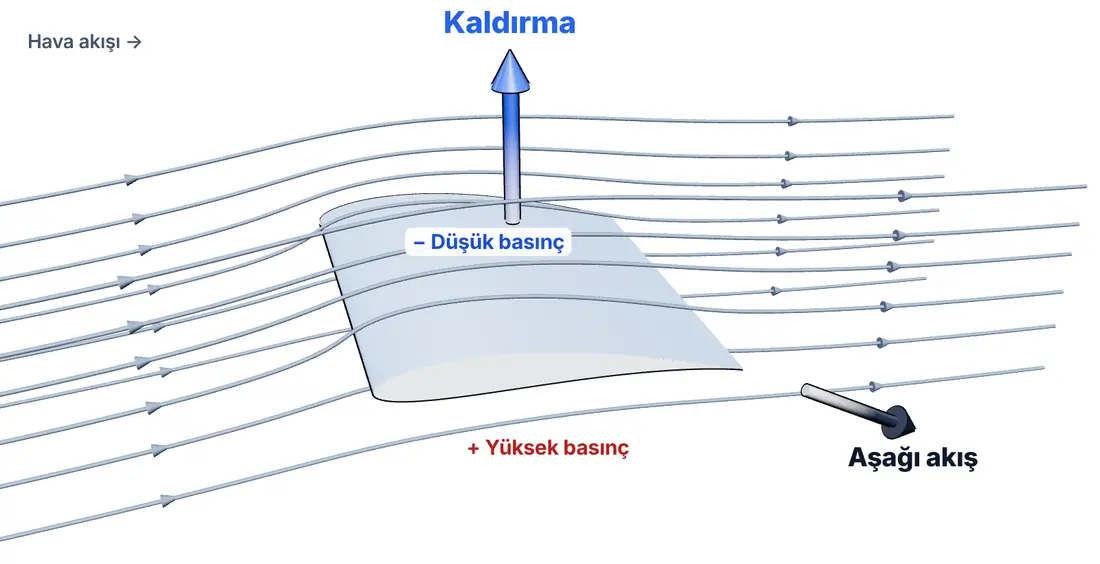
A wing changes the direction of the air it passes through. A wing set at an angle of attack, or a cambered (curved) wing, deflects the air flowing over and under it downwards. This downward flow behind the wing is called downwash.
You can look at this in two ways, and both are correct:
Newton's view
The wing pushes the air down. According to Newton's third law, the air pushes the wing up with a force of the same size. The more you change the direction of the air, the more lift you get.
The pressure-difference view
When air follows a curved path, the pressure drops on the inside of that curve. Along the upper surface the air bends down around the wing, and the pressure on the upper surface falls below the ambient pressure. On the lower surface the pressure rises slightly. This pressure difference between the upper and lower surfaces produces the net force that pushes the wing up. Where the pressure drops, the air speeds up; that is the relationship described by Bernoulli's equation.
In NASA's words, "Bernoulli" and "Newton" are not two rival explanations but two sides of the same phenomenon. Whether you add up the pressure distribution over the wing or calculate the change in the air's momentum, you get the same lift force.
Why does this matter?
- The upper surface is critical. A large part of the lift comes from the pressure drop on the upper surface. Ice, frost, mud or torn covering on the wing disturb this flow and reduce lift. Check your model's wing before you fly.
- A symmetric wing flies too. Aerobatic models use symmetric airfoils; they produce lift through the angle of attack and behave similarly when inverted.
- To get more lift, turn more air. That depends on speed, angle of attack, wing area and airfoil shape. In the next step we will bring these together in the lift equation.
Try it yourself
A symmetric section produces no lift at zero angle of attack; a cambered section does. Change the angle to compare the two sections, and see what happens at negative angles.
JavaScript must be enabled in your browser for this interactive tool.
Next step
We will see in a single equation which variables lift depends on: why does lift quadruple when the speed doubles, and why do airplanes need longer runways in high and hot places?
Sources
- NASA Glenn Research Center. Equal Transit Theory Interactive
- NASA Glenn Research Center. What is Lift?
- NASA Glenn Research Center. Bernoulli and Newton
- Babinsky, H.. How do wings work? Physics Education, 38(6), 497–503 (2003). University of Cambridge, Department of Engineering
This article was written by SVR AEROTECH as original work, drawing on the sources above; the figures belong to SVR AEROTECH. Quoted information belongs to the respective source owners.