
In the previous step we saw that the airplane rotates around three axes and that these axes meet at the centre of gravity. In this step we explain why this point is so important.
What is the centre of gravity?
Every part of an airplane has a weight. The centre of gravity (CG) is the average position of all these weights. If you could hold the airplane at exactly this point with one finger, it would stay balanced without tipping forward or backward.
As NASA puts it, when the control surfaces produce a force, the airplane rotates around this point. How the airplane behaves is largely determined by where the CG lies relative to the wing.
How is the centre of gravity calculated?
The calculation is simple: a reference point is chosen, here the tip of the nose. The weight of each part is multiplied by its distance from the reference. The sum of these products is divided by the total weight.
CG = Σ(weight × distance) / Σ(weight)
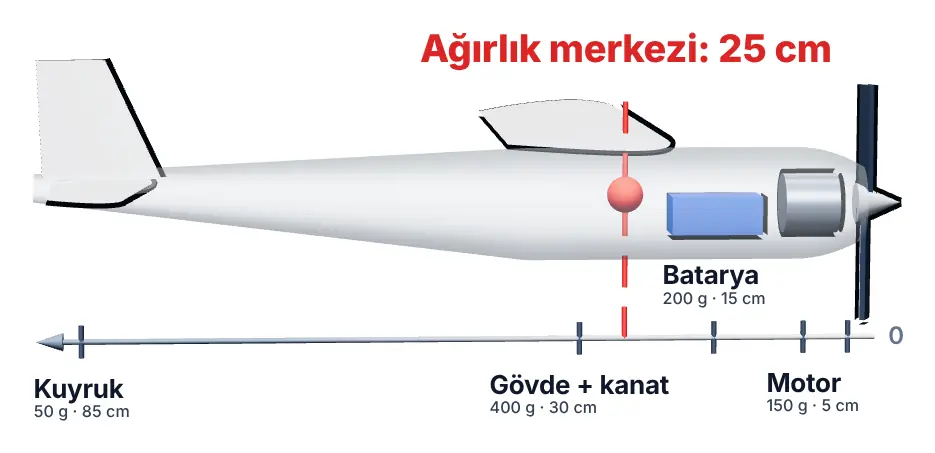
In the example the motor is 150 g (5 cm), the battery 200 g (15 cm), the fuselage and wing 400 g (30 cm) and the tail 50 g (85 cm). The total weight is 800 g and the sum of the products is 20,000 g·cm. The centre of gravity is 25 cm behind the nose.
Now let us move the 200 g battery, which sits 15 cm behind the nose, 5 cm forward to 10 cm. The battery's product drops from 200 × 15 = 3,000 to 200 × 10 = 2,000, and the total becomes 19,000. The new CG: 19,000 / 800 = 23.75 cm. So moving a 200 g battery by 5 cm moves the centre of gravity 1.25 cm forward. This is also the easiest way to adjust the balance of a model airplane: changing where the battery sits.
If the CG is too far forward
- The airplane becomes more stable; when disturbed, it tends more strongly to return to level flight by itself.
- But raising the nose becomes harder. The tail has to produce more downward force to lift the nose.
- This extra tail force increases the load the wing must carry. According to the FAA's handbook, this raises the stall speed.
- On landing it may be harder to raise the nose and make a soft touchdown.
If the CG is too far back
- The airplane becomes less stable; it reacts very sensitively to the controls and needs constant correction.
- If the CG moves behind a certain limit, the airplane becomes unstable and may be uncontrollable.
- Recovering from stalls and spins becomes harder.
Balancing a model airplane
- Find the CG position given by the manufacturer. In the instructions of kits and ready-built models, the centre of gravity is given as a distance measured from the wing's leading edge. As a general rule of thumb, this point is usually between about a quarter and a third of the mean aerodynamic chord (MAC) from the front. On tapered or swept wings, measuring from the root chord gives the wrong result; always go by your own model's instructions.
- Make the airplane ready to fly. The battery, propeller and all equipment should be installed. Nothing that will not be on board in flight should be attached.
- Lift it with two fingers at the CG point. If the airplane sits level or slightly nose-down, the balance is right. If the tail drops, the CG is too far back.
- Adjust. First try moving the battery. If that is not enough, add a small weight to the nose. If you find you need to add weight to the tail, check the instructions again before doing it.
Try it yourself
The example parts from this post are already loaded in the tool. Weigh your own model's parts and enter their distances from the nose; the tool calculates the centre of gravity, at what percentage of the chord it lies, and how far you need to move the battery.
JavaScript must be enabled in your browser for this interactive tool.
Next step
We saw in the lift equation that air density matters. In the next step we will get to know the atmosphere: why does the air get "thinner" as you climb, and how does a hot summer day affect an airplane's performance?
Sources
- NASA Glenn Research Center. Center of Gravity
- NASA Glenn Research Center. Aircraft Center of Gravity
- Federal Aviation Administration (FAA). Pilot's Handbook of Aeronautical Knowledge (FAA-H-8083-25C). Chapter 10: Weight and Balance; Chapter 5: Aerodynamics of Flight
This article was written by SVR AEROTECH as original work, drawing on the sources above; the figures belong to SVR AEROTECH. Quoted information belongs to the respective source owners.