
In the lift equation we saw that air density (ρ) directly affects lift. In this step we get to know the air itself. Why does the same airplane that lifts off in a short distance in the cool of the morning need a longer runway in the midday heat?
The standard atmosphere
Because the weather changes all the time, aviation uses a common reference for comparisons: the International Standard Atmosphere (ISA). According to ISA, at sea level:
- Temperature: 15 °C
- Pressure: 1013.25 hPa
- Density: about 1.225 kg/m³
In the troposphere, the lowest layer of the atmosphere, up to about 11 km, the temperature falls by about 6.5 °C for every 1,000 metres. In the model used by NASA this relationship is T = 15.04 − 0.00649·h (T in °C, h in metres).
The air gets thinner as you climb
As you climb, both pressure and density decrease. At about 1,000 metres the density is 9% lower than at sea level, and at about 3,000 metres it is 26% lower.
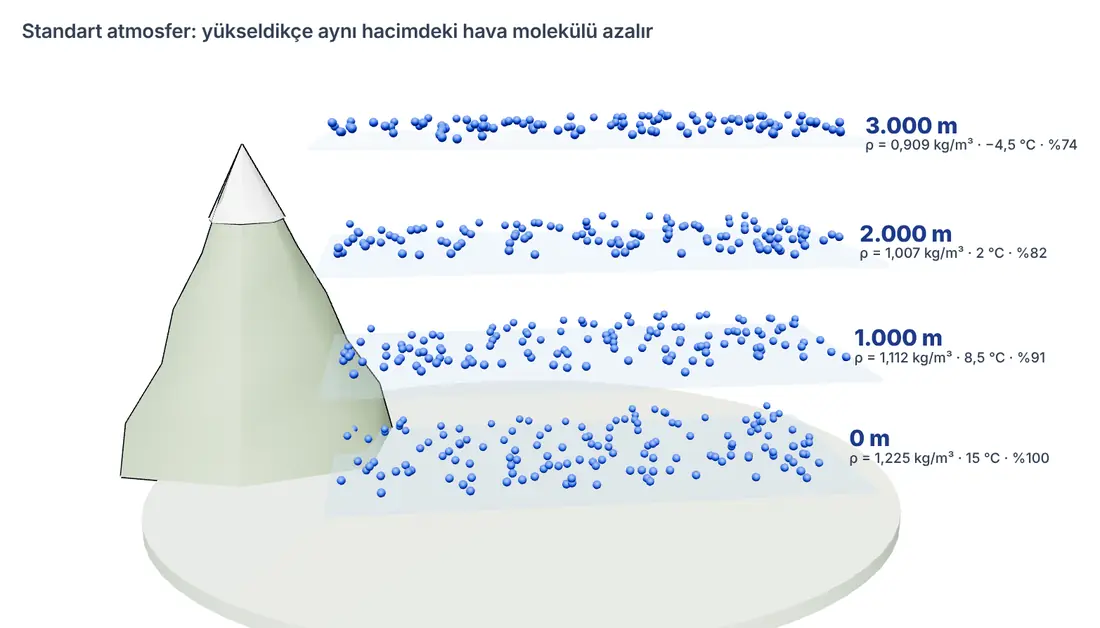
Thinner air means:
- The wing produces less lift. A higher true speed is needed for the same lift.
- The propeller produces less thrust. It accelerates a smaller mass of air.
- Fuel-burning engines produce less power. The mass of air entering the cylinder decreases.
The effect of temperature
As air warms up it expands and its density drops. Let us calculate the density of air at sea level, at standard pressure but at 30 °C (ideal gas law, ρ = p / (R·T)):
ρ = 101,325 / (287.05 × 303.15) ≈ 1.164 kg/m³
This is about 5% lower than on a standard day. The true speed needed to produce the same lift increases with the square root of the density ratio: √(1.225 / 1.164) ≈ 1.026. So the airplane has to run about 2.6% faster over the ground to take off (the take-off speed read on the pilot's airspeed indicator stays roughly the same). As the speed increases, the take-off distance grows even more; on top of that, the engine and propeller produce less thrust at the same time.
Density altitude
Pilots express all these effects with a single number: density altitude. It is the height in the standard atmosphere at which the air has the same density as the air where you are. In the FAA's definition, density altitude is pressure altitude corrected for non-standard temperature.
For example, at sea level on a 30 °C day the air density corresponds to the density at about 500 metres in the standard atmosphere. Although the airplane is standing at sea level, it performs as if it were at about 500 metres.
Practical consequences for model flyers and rocketeers
- On summer afternoons your model needs a longer take-off run and climbs more slowly. If you take off from a short field, choose the cool of the morning.
- When you go to a high-elevation field, the throttle and take-off habits you are used to may not be enough; leave more distance on the first flights.
- With model rockets things are slightly different: because drag is lower in thin air, the same rocket usually goes a little higher. The rocket flight simulator on our site takes this effect into account through field elevation and temperature.
Try it yourself
Enter the elevation of your flying field and the day's weather values. The example from this post (sea level, 30 °C) is already loaded in the tool.
JavaScript must be enabled in your browser for this interactive tool.
Next step
We move on to the part that produces thrust: how does a propeller push the air, what do propeller sizes such as "10x6" mean, and what should you look out for when choosing a propeller?
Sources
- NASA Glenn Research Center. Earth Atmosphere Equation – Metric
- Federal Aviation Administration (FAA). Pilot's Handbook of Aeronautical Knowledge (FAA-H-8083-25C). Chapter 4: Principles of Flight (atmosphere); Chapter 11: Aircraft Performance (density altitude)
- ICAO. Manual of the ICAO Standard Atmosphere (Doc 7488). Standard atmosphere values
- NASA Glenn Research Center. Lift Equation
This article was written by SVR AEROTECH as original work, drawing on the sources above; the figures belong to SVR AEROTECH. Quoted information belongs to the respective source owners.