
In the previous step we saw that induced drag is the price of lift and is related to the wingtip vortices. The way to produce the same lift with less induced drag lies in the shape of the wing.
The numbers that describe a wing
Using the definitions on NASA's wing geometry page:
- Span (b): The distance from one wingtip to the other.
- Chord (c): The distance from the leading edge to the trailing edge. On a tapered wing it differs at the root and at the tip.
- Wing area (S): The area of the wing seen from above.
- Aspect ratio (AR): AR = b² / S. On a rectangular wing this equals the ratio of span to chord.
- Taper ratio (λ): The ratio of the tip chord to the root chord.
For example, a rectangular wing with a span of 140 cm and a chord of 25 cm has an area of 35 dm² and an aspect ratio of 140² / 3,500 = 5.6. On typical trainer models the aspect ratio is 5–7; on gliders it can be 12–20 or more.
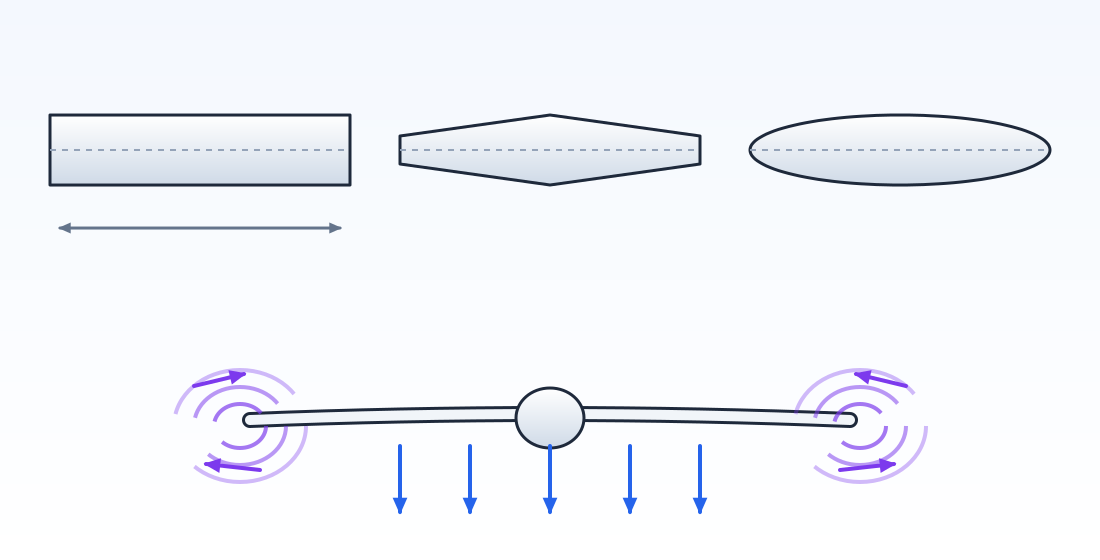 b (span)RectangularTapered (tip/root ≈ 0.4)EllipticalAR = b² / Slow pressureDownwashWingtip vortexWingtip vortexhigh-pressure air curls around the tip to the topRear view
Why is a long, slender wing more efficient?
Let us recall the induced drag coefficient: Cᴅᵢ = Cʟ² / (π · e · AR). The aspect ratio is in the denominator. With everything else equal, doubling the aspect ratio halves the induced drag.
The physical explanation lies in the wingtip vortices. At the wingtip, the high-pressure air from below curls around to the top. On a long, slender wing the tips are a small region compared with the wing's total area; the part affected by the vortex is a smaller share of the wing. This is why gliders, long-range airplanes and unmanned surveillance airplanes have long wings.
There is a price too: a long, slender wing is heavier, bends more and responds more slowly to roll. This is also why aerobatic models have short, wide wings.
Elliptical distribution and the tapered wing
How lift is distributed along the wing also matters. Theory says that for a given span and lift, the least induced drag is obtained with an elliptical lift distribution; in NASA's equation this corresponds to e = 1.
An elliptical planform is hard to build. Fortunately, a tapered wing (narrowing towards the tip) comes very close to the elliptical distribution. In a calculation using Prandtl's lifting-line theory, for a wing with an aspect ratio of 6:
- Rectangular wing (λ = 1): e ≈ 0.95; about 5% more induced drag than elliptical
- Tapered wing (λ ≈ 0.4): e ≈ 0.99; the difference is about 1%
Where does the wing stall first?
The planform also decides where on the wing the stall will start. On a rectangular wing the local lift coefficient at the wingtip is low; the stall starts first near the root. Because the ailerons are further out, they remain effective even during the stall. This is a desirable property for trainers.
On a strongly tapered wing, however, the local lift coefficient increases towards the tip; the stall can start at the tip. If one wingtip stalls before the other, the airplane can suddenly roll to that side and the ailerons lose their effect. That is why on tapered wings the tip section is usually set at an angle a few degrees lower than the root (twist, "washout").
Wingtip devices
Vertical fins at the wingtip (winglets) reduce induced drag by weakening the tip vortex. This idea, developed by NASA, is used today on many airliners. They are also seen on model airplanes; however, their effect can be similar to slightly increasing the wingspan, so they do not bring a gain in every design.
Try it yourself
Change the wingspan, the root chord and the tip/root ratio. The blue bars show lift along the wing, and the dashed line shows the elliptical distribution for the same total lift. Reduce the tip/root ratio from 1 to 0.4, then to 0.2: watch how the red marker (where the stall starts first) moves from the root towards the tip.
JavaScript must be enabled in your browser for this interactive tool.
Next step
We have seen the shape of the wing and drag. In the next step we will talk about why an airplane corrects itself, that is, stability: how do dihedral and the tail play a role in this?
Sources
- NASA Glenn Research Center. Wing Geometry Definitions
- NASA Glenn Research Center. Induced Drag Coefficient
- NASA Glenn Research Center. Winglets
- Federal Aviation Administration (FAA). Pilot's Handbook of Aeronautical Knowledge (FAA-H-8083-25C). Chapter 5: Aerodynamics of Flight (wingtip vortices, planform and stall)
- John D. Anderson. Fundamentals of Aerodynamics. Prandtl's lifting-line theory, induced drag of tapered wings
This article was written by SVR AEROTECH as original work, drawing on the sources above; the figures belong to SVR AEROTECH. Quoted information belongs to the respective source owners.