
In the previous step we saw that the wing produces lift by turning the air downwards. Engineers calculate this force with a single equation. Once you understand this equation, you also understand why an airplane cannot fly below a certain speed.
The lift equation
L = ½ · ρ · V² · S · Cʟ
- L: Lift force (newton, N)
- ρ (rho): Air density (kg/m³). At sea level and 15 °C it is about 1.225 kg/m³.
- V: Speed of the airplane relative to the air (m/s)
- S: Wing area (m²)
- Cʟ: Lift coefficient. A dimensionless number that depends on the wing's airfoil and angle of attack.
The term ½·ρ·V² in the equation is called dynamic pressure. It represents the kinetic energy per unit volume of the moving air.
What does each term tell us?
Speed: the strongest factor
Speed appears in the equation squared. If the speed doubles and everything else stays the same, lift becomes four times larger. If the speed is halved, lift drops to a quarter. That is why airplanes must reach a certain speed to take off.
Air density: how "thick" the air is
If density drops, lift drops by the same proportion. Density is lower at high-altitude places and in hot weather. That is why the same airplane needs a longer take-off run on a hot summer day or on a high-elevation runway. We will come back to this in the atmosphere step.
Wing area: a bigger wing, more lift
If the wing area doubles, lift doubles too. The large wings of gliders and trainers are there to produce enough lift even at low speed.
Lift coefficient and angle of attack
The angle of attack (α) is the angle between the wing's chord line (the line joining the leading edge and the trailing edge) and the relative wind. It is not the same as how far the airplane's nose is above the horizon.
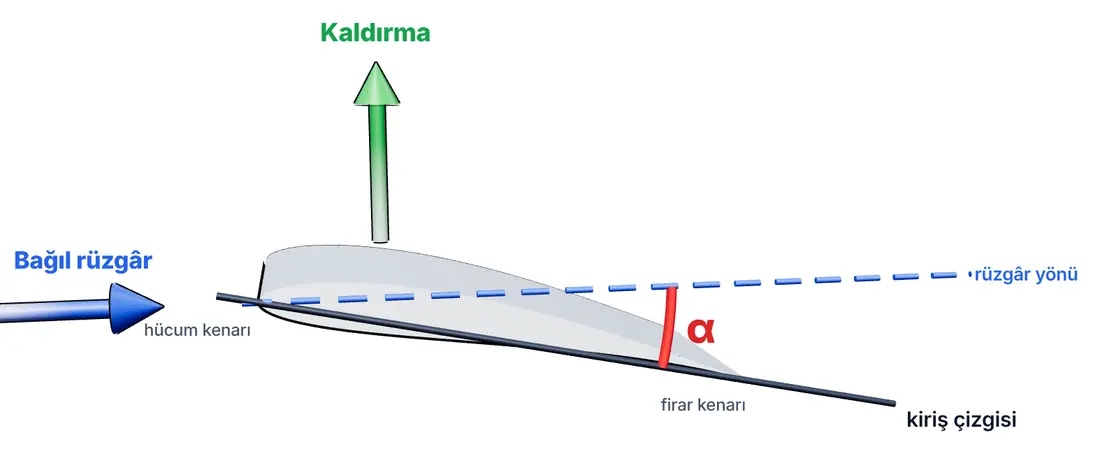
At small angles the lift coefficient increases roughly linearly with the angle of attack. According to NASA, for thin airfoils this relationship holds up to about ±10 degrees. When the angle exceeds a certain value, the air separates from the upper surface and lift drops suddenly. This is called a stall, and it is the subject of the next step.
Let us do a calculation for a model airplane
Consider a trainer model with a mass of 1.2 kg and a wing area of 0.25 m². It flies at sea level in standard conditions (ρ = 1.225 kg/m³).
- Weight: W = m · g = 1.2 × 9.81 ≈ 11.8 N
- In level flight lift must equal weight: L = W
- Solving the equation for speed: V = √( 2W / (ρ · S · Cʟ) )
Let us assume that in slow, gentle flight the wing works at Cʟ ≈ 0.8 (at cruise speed this value is lower):
V = √( 2 × 11.8 / (1.225 × 0.25 × 0.8) ) = √( 23.5 / 0.245 ) ≈ 9.8 m/s (about 35 km/h)
Let us assume the highest lift coefficient this wing can reach (Cʟ,max) is 1.2. The lowest speed at which the airplane can hold level flight, the stall speed, is:
V_stall = √( 23.5 / (1.225 × 0.25 × 1.2) ) ≈ 8.0 m/s (about 29 km/h)
Wing loading: a practical measure
A measure that model flyers use often is wing loading: the ratio of weight to wing area. In our example it is 1,200 g / 25 dm² = 48 g/dm². As the equation shows, the stall speed increases with the square root of the wing loading. If you add 300 g to the same wing, the stall speed rises by about 12% (√(1.5/1.2) ≈ 1.12).
Try it yourself
The values from the example in this post are already loaded in the tool. Enter your own model's mass and wing area to calculate its stall speed and wing loading; see what changes when you raise the altitude and the temperature.
JavaScript must be enabled in your browser for this interactive tool.
Summary
- Doubling the speed quadruples the lift.
- When density drops, lift drops; in hot and high places a higher true speed (speed over the ground) is needed for take-off.
- As weight increases, the minimum speed the airplane needs to stay in the air increases too.
- Angle of attack increases lift, but only up to the critical angle.
Next step
Is a stall just "flying too slowly"? No. In the next step we will look at why an airplane can stall at any speed and why the stall speed rises in turns.
Sources
- NASA Glenn Research Center. Lift Equation
- NASA Glenn Research Center. Inclination Effects on Lift
- Federal Aviation Administration (FAA). Pilot's Handbook of Aeronautical Knowledge (FAA-H-8083-25C). Chapter 4: Principles of Flight; Chapter 5: Aerodynamics of Flight
This article was written by SVR AEROTECH as original work, drawing on the sources above; the figures belong to SVR AEROTECH. Quoted information belongs to the respective source owners.