
In the previous step we saw that lift increases with the angle of attack, but not without limit. In this step we look at one of the most important concepts in aviation: the stall.
What is a stall?
A stall is the sudden loss of lift that happens when the wing exceeds its critical angle of attack. Up to this angle the air follows the upper surface of the wing. When the angle increases a little further, the air separates from the upper surface, irregular vortices form behind the wing and lift drops suddenly.
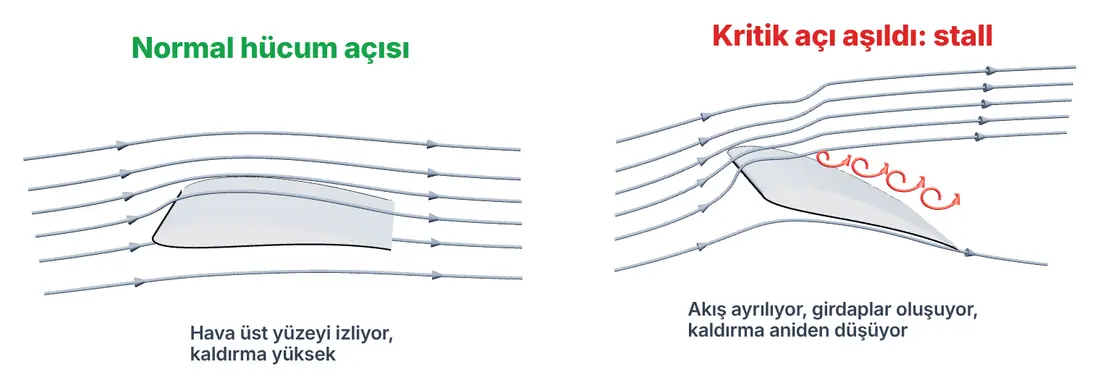
Let us correct a common mistake here: an aerodynamic "stall" does not mean the engine stopping. A wing can stall while the engine is running at full power.
The most important rule: a stall is a matter of angle
The FAA's pilot handbook stresses this point: an airplane can stall at any airspeed, in any attitude and at any power setting. What decides it is not the speed but the wing's angle of attack.
So why is a "stall speed" given for airplanes? Because in level flight, at a given weight, it is the lowest speed at which the airplane can stay in the air without bringing the wing to the critical angle. Below this speed, producing enough lift to hold the airplane up would require exceeding the critical angle. But this number is valid only for the stated conditions. Weight, turns and manoeuvres change the stall speed.
Why does the stall speed rise in a turn?
To turn, an airplane banks. When it banks, the lift force tilts; part of it turns the airplane and the rest carries the weight. To hold altitude, the wing must produce more lift in total. The ratio of the load carried by the wing to the weight is called the load factor (n), and in a level turn n = 1 / cos(bank angle).
The stall speed increases with the square root of the load factor:
- 30° bank: n ≈ 1.15 → the stall speed rises by about 7–8%
- 45° bank: n ≈ 1.41 → the stall speed rises by about 19%
- 60° bank: n = 2 → the stall speed rises by about 41%
The stall speed of the example model from the previous step was 8.0 m/s in level flight. In a 60° banked turn it rises to about 11.3 m/s. So at a speed where it flies comfortably in level flight, it can stall in a steep turn.
The effect of weight
As weight increases, a higher speed or a larger angle of attack is needed to produce the same lift. That is why a heavily loaded model stalls at a higher speed. As we saw in the previous step, the stall speed increases with the square root of the weight.
Signs of a stall and recovery
An airplane approaching a stall usually shows the following:
- The controls "go soft"; the airplane reacts late and weakly to inputs.
- The airplane starts to lose altitude even though the nose is high.
- One wing may drop suddenly; the airplane rolls to one side.
The basic rule of recovery is to reduce the angle of attack. The basic sequence described in the FAA's flying handbook is:
- Reduce the angle of attack: Release the elevator input and lower the nose as much as needed until the stall signs disappear. The wing starts producing lift again.
- Level the wings: Bring the airplane level with the ailerons.
- Use power appropriately: If needed, increase the throttle to regain speed, then return smoothly to level flight.
Try it yourself
Enter the level-flight stall speed and your flying speed, then increase the bank angle. See at which bank angle your stall margin runs out.
JavaScript must be enabled in your browser for this interactive tool.
Summary
- A stall is exceeding the critical angle of attack; it can happen at any speed.
- The stall speed rises in turns and when the load increases.
- The key to recovery is reducing the angle of attack.
Next step
How do we control the angle of attack, the bank and the direction? In the next step we will get to know the airplane's three axes and the control surfaces that produce motion around them.
Sources
- Federal Aviation Administration (FAA). Pilot's Handbook of Aeronautical Knowledge (FAA-H-8083-25C). Chapter 5: Aerodynamics of Flight (angle of attack, stall, load factor)
- Federal Aviation Administration (FAA). Airplane Flying Handbook (FAA-H-8083-3C). Stalls and recovery
- NASA Glenn Research Center. Inclination Effects on Lift
This article was written by SVR AEROTECH as original work, drawing on the sources above; the figures belong to SVR AEROTECH. Quoted information belongs to the respective source owners.