
Over fifteen steps we have seen why an airplane flies, how it is controlled and what determines its performance. In the last step we take this knowledge to the field.
Choosing your first model airplane
Every topic in the series gives a hint for choosing your first airplane:
- High wing and noticeable dihedral (step 11): A model with its wing on top of the fuselage, forming a slight V when seen from the front, tends to correct itself when you let go of the controls.
- Low wing loading (steps 3 and 4): A model with a large wing for its weight flies slowly and stalls late. It buys you time to think.
- Correct centre of gravity (step 6): Even on ready-built models, check the centre of gravity at the point given in the instructions before the first flight.
- Durable construction: Models with foam (such as EPO) airframes withstand crashes and are easy to repair.
- Electric power (step 15): Easy to maintain and quiet; the flight time can be calculated.
- Stabilisation: Many beginner models have electronic stabilisation that levels the airplane when the controls are released. It is useful but no substitute for learning to fly.
Aerobatic models, scale warbirds and jets are not suitable as a first model: they are fast, have low stability and do not forgive small mistakes.
Simulator first, then an instructor
The fastest way to learn to fly a model airplane has two steps:
- Simulator: Flying on a computer with your real transmitter makes the control directions become reflexes. In particular, left and right appearing reversed when the airplane is coming towards you is learned safely in the simulator.
- An experienced instructor: At a model airplane club, flying with a "trainer system", where the instructor's transmitter is linked to yours by cable or wirelessly, greatly reduces the risk of a crash on the first flights.
Pre-flight checklist
- Is the battery charged and in good condition? (step 15)
- Is the centre of gravity correct? (step 6)
- Do the control surfaces move in the right direction? Check with the propeller removed. (step 5)
- Is the propeller free of cracks and tight? (step 8)
- Range check: Check the link from a distance using your transmitter's range check mode.
- What is the wind direction and strength? (steps 13 and 14)
- Is the throttle stick all the way down before you connect the battery?
Rules: SHGM Unmanned Aircraft Systems Instruction (2026)
The Turkish Directorate General of Civil Aviation (SHGM) published the new Unmanned Aircraft Systems Instruction (SHT-İHA) on 30 July 2026. Radio-controlled model airplanes are also considered within this framework because they fly without a pilot on board. The key points of the Instruction for hobby flying:
Classes (Article 8)
- Simple UAS ("Basit İHA"): Toy-like aircraft that, by design, cannot leave a cylinder with a horizontal radius of 10 m and a height of 20 m. They are exempt from licensing, registration and import conformity obligations. A typical model airplane does not fall under this definition.
- M0: 500 g to 4 kg
- M1: 4 kg to 25 kg
- M2: 25 kg to 150 kg
- M3: 150 kg and above
Aircraft under 500 g that do not fall under the simple UAS definition are subject to the M0 provisions.
Licence: P0 (Articles 15 and 17)
Non-commercial amateur flights are made with a P0 licence. P0 flights are made:
- in daylight,
- within visual line of sight (VLOS),
- within a flight envelope limited to at most 120 m height and 3,000 m distance.
A minimum age of 10 is required for P0. After training at an authorised training organisation and passing the exam, the licence is used with an operating licence obtained through the KDM-ERP system.
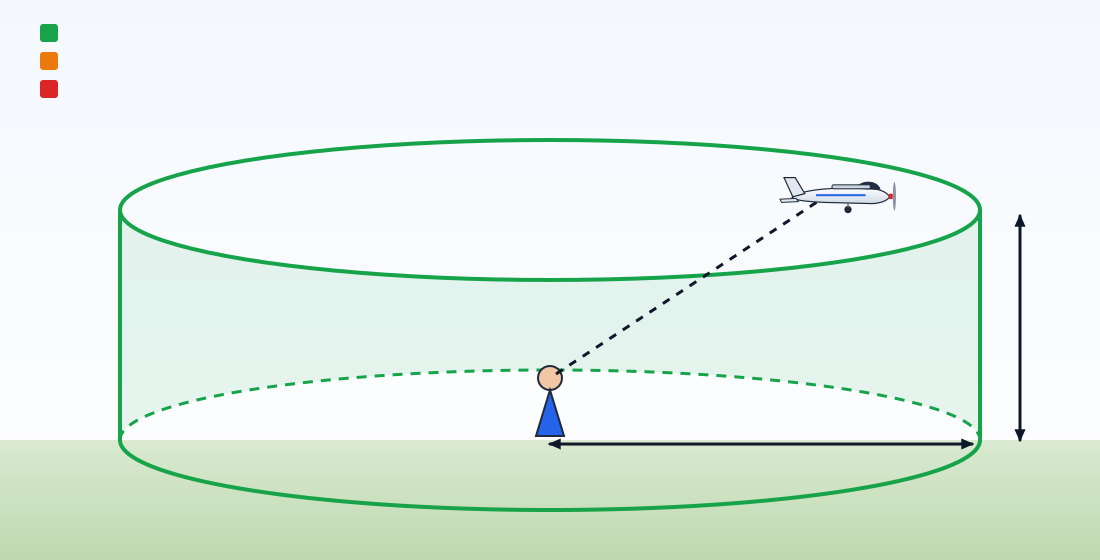 120 m3,000 mPilotvisual line of sight (VLOS)P0 (amateur) flight envelopedaylight · within line of sight · at most 120 m height and 3,000 m distanceGreen zone: no permission neededOrange zone: permitted flight areaRed zone: closed to flight
Registration and remote ID (Articles 11 and 23)
All UAS other than simple UAS are registered in the İHATTYS system. A remote ID system is also mandatory for aircraft subject to registration.
Where can you fly? (Article 12)
The Instruction defines three zones on the map:
- Green zone: P0 and P1 users can fly without obtaining a separate flight permission through the system.
- Orange zone: An area with a valid flight permission or airspace allocation.
- Red zone: An area closed to flight by the relevant authority.
Areas outside these three zones are considered restricted and require permission. Before flying, check the status of your field on the İHATTYS map.
Safety at the field
- Do not fly over people, vehicles or buildings.
- Do not fly near airports; manned air traffic always has priority.
- Keep the model within your line of sight. A model with a 1.5 m span turns into a hard-to-see dot after a few hundred metres; the line-of-sight limit usually comes long before 3,000 m.
- While the propeller is running, do not stand in the plane of the propeller, and always hold the model from behind.
- Use a fireproof container when carrying and charging LiPo batteries.
The end of the series, the start of flying
Over sixteen steps we have gone from the four forces all the way to the rules at the field. With the tools in these articles you can calculate your own model's wing loading, centre of gravity, take-off distance and flight time. Our flight lab is also always open for you to experiment before going out to a real field.
Try it yourself
Enter your model's mass and the flight you are planning. The tool shows the class under the Instruction, the registration status and whether your flight stays within the P0 limits. Raise the altitude to 150 m or set the time to "Night"; see the cylinder turn red.
JavaScript must be enabled in your browser for this interactive tool.
Sources
- Sivil Havacılık Genel Müdürlüğü (SHGM). İnsansız Hava Aracı Sistemleri Talimatı (SHT-İHA). Article 8 (classes), 11 (registration), 12 (zones), 15 (licence levels), 17 (age), 23 (remote ID), transitional provisions
- Sivil Havacılık Genel Müdürlüğü (SHGM). İnsansız Hava Aracı Sistemleri Talimatı (SHT-İHA) Yayımlanmıştır. Announcement, 30 July 2026
- Academy of Model Aeronautics (AMA) Flight School. LiPo Battery Basics
- Federal Aviation Administration (FAA). Pilot's Handbook of Aeronautical Knowledge (FAA-H-8083-25C). Chapter 5: stability; Chapter 11: performance
This article was written by SVR AEROTECH as original work, drawing on the sources above; the figures belong to SVR AEROTECH. Quoted information belongs to the respective source owners.